Not sure where to begin in your improvement plan? Start with the Literacy Excellence Health Check™. Start here

Tuesday 20 October 2026, 3:00 to 6:00 pm AWST. Online workshop plus group coaching.

Linking effective reading and writing instruction in the literacy block
(Years 2 to 6), for teachers

Take the guesswork out of connecting reading and writing in the structured literacy block.

You may have devoured the books, listened to the podcasts and followed the science of reading discussions in Facebook groups. Yet the classroom question remains: Which practices will make the greatest impact on my students’ reading and writing, and how do I fit them all in?

Perhaps you’ve begun implementing structured literacy but aren’t seeing the progress you expected. Perhaps your reading and writing lessons are each well planned, but the connection between them still feels unclear.

In this practical session, we will start with the essentials of the literacy block, then discuss the importance of more ‘eyes on text’ through daily reading of complex texts, written responses, sentence instruction and text-level writing. You’ll see how scaffolded choral reading can help students access and revisit a demanding text through repeated reading approaches and queries, and how that same text can become a worked example when you teach students to write.

The aim is to take the confusion out of planning: what to teach, how the parts connect, what to prioritise and what you may be able to let go.

What you’ll learn

Make complex texts part of the daily literacy block

We’ll look at why students need regular, supported opportunities to read complex texts, and how scaffolded choral reading can give them access to the language, ideas and text structures they will later discuss and write about. You’ll also see the research showing that when all students read complex texts, including those with much lower reading accuracy, they make significant gains in reading accuracy and fluency.

Build comprehension through knowledge, discussion and writing

Explore how background knowledge helps students understand what they read, and practical ways to connect students to that knowledge. We’ll examine comprehension monitoring, how readers build a mental model of a text, and how to support students with inference, summarising and getting the gist routines.

You’ll learn how to use interspersed queries during reading, including Questioning the Author (QtA). We’ll also look at examples of written responses to reading that can be used to improve students’ comprehension of what they are reading.

Plan the move into sentence and text-level writing

Learn how to link different genres to your rich texts and knowledge-rich units. We’ll examine an example of a linked reading and writing scope and sequence that identifies the rich text, genre and writing focus, as well as the sentence and grammar and punctuation level focus so the connection is visible in your planning.

You’ll also receive a brief introduction to Self-Regulated Strategy Development (SRSD) as an approach to teaching text-level writing. SRSD has repeatedly demonstrated significant, strong effects in research on text level writing instruction and executive function. We will look at what the approach involves, how it can connect to reading and knowledge-rich units, and real case studies showing its impact on students’ writing.

Use assessment to decide what comes next

Learn how to assess reading comprehension in relation to the texts and knowledge-rich units students have actually studied, and use what you learn to make better instructional decisions for teaching and learning and end of semester reporting.

Throughout the workshop, we’ll return to the questions teachers are juggling:

What is essential in a structured literacy block?

Which approaches make the greatest impact? How do I know?

And what can I let go?

Who this is for

This session is ideal for teachers and literacy leaders who already have some background in structured literacy, but:

  • Aren’t seeing the impact on student reading or writing that they expected;
  • Are unsure how to fit the essential practices into the time available; or
  • Want a clearer, more practical way to link reading and writing.

Predominantly Year 2 to 6 teachers and leaders, although all are welcome

Try the routines, then come back with your questions in Group Coaching sessions

Your registration includes two 90-minute follow-up online group coaching sessions. You’ll have time to trial some of the routines with your students, notice what happens, and return for advice, discussion and answers to the questions that arise in practice. Coaching dates and joining details will be provided to participants.

Event details

When

Tuesday 20 October 2026, 3:00 to 6:00 pm AWST (Perth time), including a five-minute break

Where

Live online

Cost

$166 (inc GST) per participant

Included

Three-hour workshop and two 90-minute follow-up online group coaching sessions

Come away with a clearer way to plan reading and writing together, and supported time to put it into practice.

Take the guesswork out of connecting reading and writing, and feel confident about your structured literacy block

Includes two 90-minute follow-up online group coaching sessions

What you’ll learn

You may have devoured the books, listened to the podcasts and followed the science of reading discussions in Facebook groups. Yet the classroom question remains: Which practices will make the greatest impact on my students’ reading and writing, and how do I fit them all in?

Perhaps you’ve begun implementing structured literacy but aren’t seeing the progress you expected. Perhaps your reading and writing lessons are each well planned, but the connection between them still feels unclear.

In this practical session, we will start with the essentials of the literacy block, then discuss the importance of more ‘eyes on text’ through daily reading of complex texts, written responses, sentence instruction and text-level writing. You’ll see how scaffolded choral reading can help students access and revisit a demanding text through repeated reading approaches and queries, and how that same text can become a worked example when you teach students to write.

The aim is to take the confusion out of planning: what to teach, how the parts connect, what to prioritise and what you may be able to let go.

Make complex texts part of the daily literacy block

We’ll look at why students need regular, supported opportunities to read complex texts, and how scaffolded choral reading can give them access to the language, ideas and text structures they will later discuss and write about. You’ll also see the research showing that when all students read complex texts, including those with much lower reading accuracy, they make significant gains in reading accuracy and fluency.

Build comprehension through knowledge, discussion and writing

Explore how background knowledge helps students understand what they read, and practical ways to connect students to that knowledge. We’ll examine comprehension monitoring, how readers build a mental model of a text, and how to support students with inference, summarising and getting the gist routines.

You’ll learn how to use interspersed queries during reading, including Questioning the Author (QtA). We’ll also look at examples of written responses to reading that can be used to improve students’ comprehension of what they are reading.

Plan the move into sentence and text-level writing

Learn how to link different genres to your rich texts and knowledge-rich units. We’ll examine an example of a linked reading and writing scope and sequence that identifies the rich text, genre and writing focus, as well as the sentence and grammar and punctuation level focus so the connection is visible in your planning.

You’ll also receive a brief introduction to Self-Regulated Strategy Development (SRSD) as an approach to teaching text-level writing. SRSD has repeatedly demonstrated significant, strong effects in research on text level writing instruction and executive function. We will look at what the approach involves, how it can connect to reading and knowledge-rich units, and real case studies showing its impact on students’ writing.

Use assessment to decide what comes next

Learn how to assess reading comprehension in relation to the texts and knowledge-rich units students have actually studied, and use what you learn to make better instructional decisions for teaching and learning and end of semester reporting.

Throughout the workshop, we’ll return to the questions teachers are juggling:

What is essential in a structured literacy block?

Which approaches make the greatest impact? How do I know?

And what can I let go?

Who this is for

This session is ideal for teachers and literacy leaders who already have some background in structured literacy, but:

  • Aren’t seeing the impact on student reading or writing that they expected;
  • Are unsure how to fit the essential practices into the time available; or
  • Want a clearer, more practical way to link reading and writing.

Predominantly Year 2 to 6 teachers and leaders, although all are welcome

Try the routines, then come back with your questions in Group Coaching sessions

Your registration includes two 90-minute follow-up online group coaching sessions. You’ll have time to trial some of the routines with your students, notice what happens, and return for advice, discussion and answers to the questions that arise in practice. Coaching dates and joining details will be provided to participants.

What teachers have said

“Thank you for the session. That was one of the most inspiring and informative sessions I have attended in my 21 years of teaching. I am so looking forward to working through all the information and changing my practice to improve student success with literacy. Also, thank you for answering my million and one questions!”

Ilana, Sydney

“Thank you so much Julie for your amazing PL. I think this is the best PL I have been a part of, in relation to Literacy Blocks and the Big 6. I am the Literacy Coordinator at my school, and I will be imparting the knowledge and understandings that I have learnt from your PL to improve the literacy standards in our school”

Kylie, Perth

Other PL feedback

“I thought it was the best PD I’ve done! Informative, evidence based. relevant and practical. Thank you!”

“I was super engaged and I loved how supportive and positive you were when we had questions or things to run by you.”

“This was an engaging and practical session. You made the content clear, and I appreciated the way you connected the research to classroom practice. It gave us concrete steps to work on as a whole school, and I left feeling confident about next steps in literacy.”

“Very engaging and knowledgeable. The day was very enjoyable and was able to take so much away from it so thank you!”

“You did great Julie! Was so good to hear you present in person and I took a lot of out of it!”

“Your presentation gave me a lot of food for thought. Thank you.”

“Thank you for your time and expertise. I know our team feel encouraged and inspired to strengthen what we are doing and try new things to see growth in our students.”

“You were engaging, positive and obviously full of knowledge about literacy. Thank you”

Wednesday 4 November 2026, 3:30 pm AWST

Upcoming info session for school leaders: Why is literacy improvement stalling in your school?

Info session for school leaders: Why is literacy improvement stalling in your school?

Wednesday 4 November 2026, 3:30 pm AWST. A practical 90 minute session for leaders who want to understand why literacy improvement may be stalling, and what conditions need to be strengthened for improvement to hold. Also for leaders starting out who want clarity about where to begin.

A practical 90 minute session for leaders who want to understand why literacy improvement may be stalling, and what conditions need to be strengthened for improvement to hold. Also for leaders starting out who want clarity about where to begin.

You’ll complete a School Improvement Heat Map using the Architectural Framework for School Excellence™ and leave with:

  • A clearer understanding of why literacy improvement may be stalling in your school
  • A practical framework for diagnosing the barriers underneath the data
  • A rationale behind the Literacy Improvement Iceberg™ and the layers below the surface
  • A completed heat map to take back to your leadership team
  • One to three possible high impact priorities for your next stage of improvement
What you’ll leave with

You’ll complete a School Improvement Heat Map using the Architectural Framework for School Excellence™ and leave with:

  • A clearer understanding of why literacy improvement may be stalling in your school
  • A practical framework for diagnosing the barriers underneath the data
  • A rationale behind the Literacy Improvement Iceberg™ and the layers below the surface
  • A completed heat map to take back to your leadership team
  • One to three possible high impact priorities for your next stage of improvement
Info session for school leaders: Why is literacy improvement stalling in your school?

Tuesday 24 November 2026

Developing an Assessment Decision Making Tree: an introduction

Tuesday 24 November 2026, 3:30 to 5:00 pm AWST. Details to come.

In person literacy professional learning events in Australia

Multi school workshops run by state, so schools can work alongside others doing similar work.
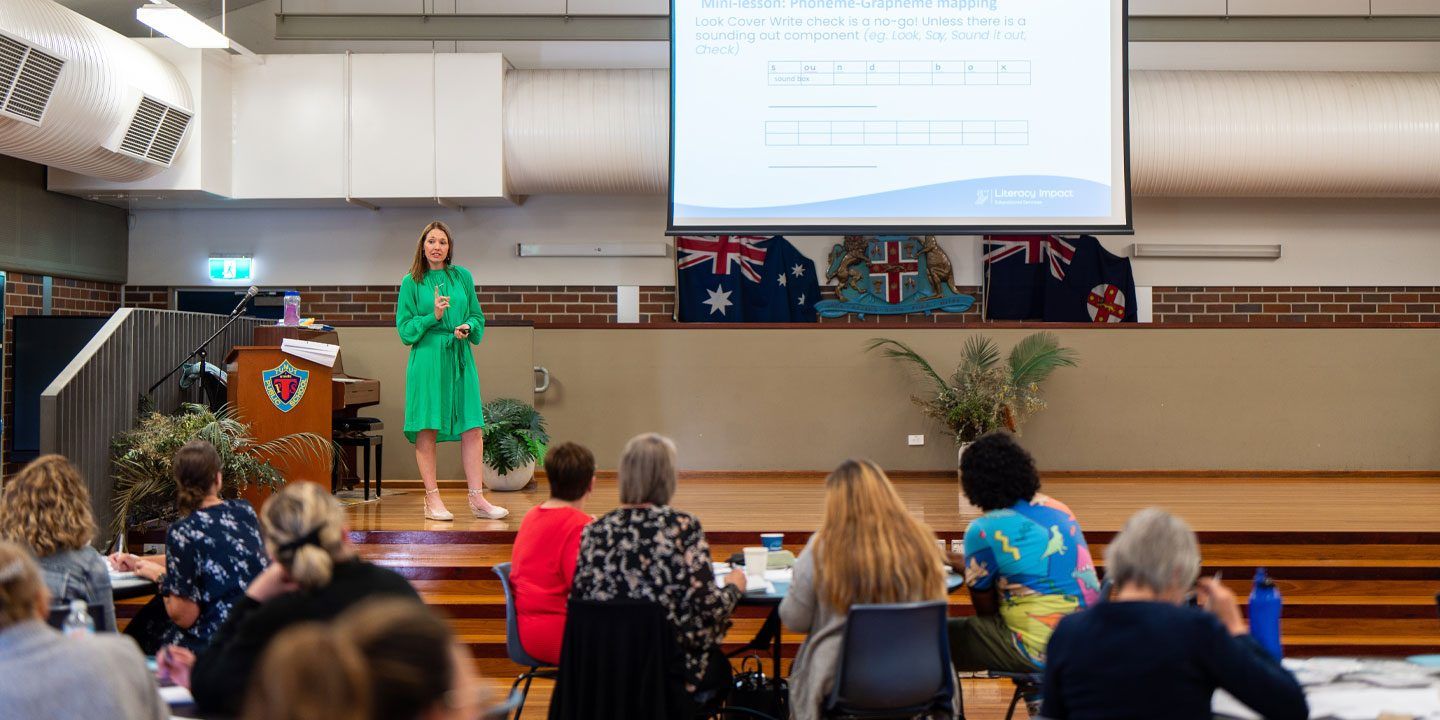
Julie Scali delivering a literacy keynote at researchED

Keynotes and conferences

Julie has presented at researchED, Learning Difficulties Australia, the Perth Hills Network, the Dyslexia SPELD Foundation, for Pivot Professional Learning, Pobble, Australian Christian College school conference, Sharing Best Practice, on behalf of Knowledge Society, Mornington Peninsula Foundation and for the Department for Education WA Centre for Excellence schools. To invite Julie to speak at your conference or network day, get in touch.

Ready for a year of supported whole school literacy improvement?

Building Literacy Excellence™ is a one year partnership that gives your leadership team clarity on what to change, in what order and how to embed it, so more students become capable readers and writers and the improvement lasts beyond any one person.

Frequently asked questions

How long are the webinars?

Webinars usually run for 90 minutes. They are information sessions that provide insight and awareness. Effective professional learning goes further, combining theory, demonstration, practice and feedback (Joyce & Showers), and that is what our in-school partnerships provide.

Can Julie speak at our conference?

Yes. Julie has presented at researchED, Learning Difficulties Australia, the Dyslexia SPELD Foundation and Sharing Best Practice. Use the enquiry form to check availability.

Do you run workshops in my state?

We run in person workshops in different states throughout the year. Workshops can also be arranged on request for schools and networks. Register your interest, and we’ll let you know when a workshop is planned near you.