“We’ve worked hard on literacy, but our data isn’t shifting as much as we hoped.”
Make your school’s literacy effort show up for every student.
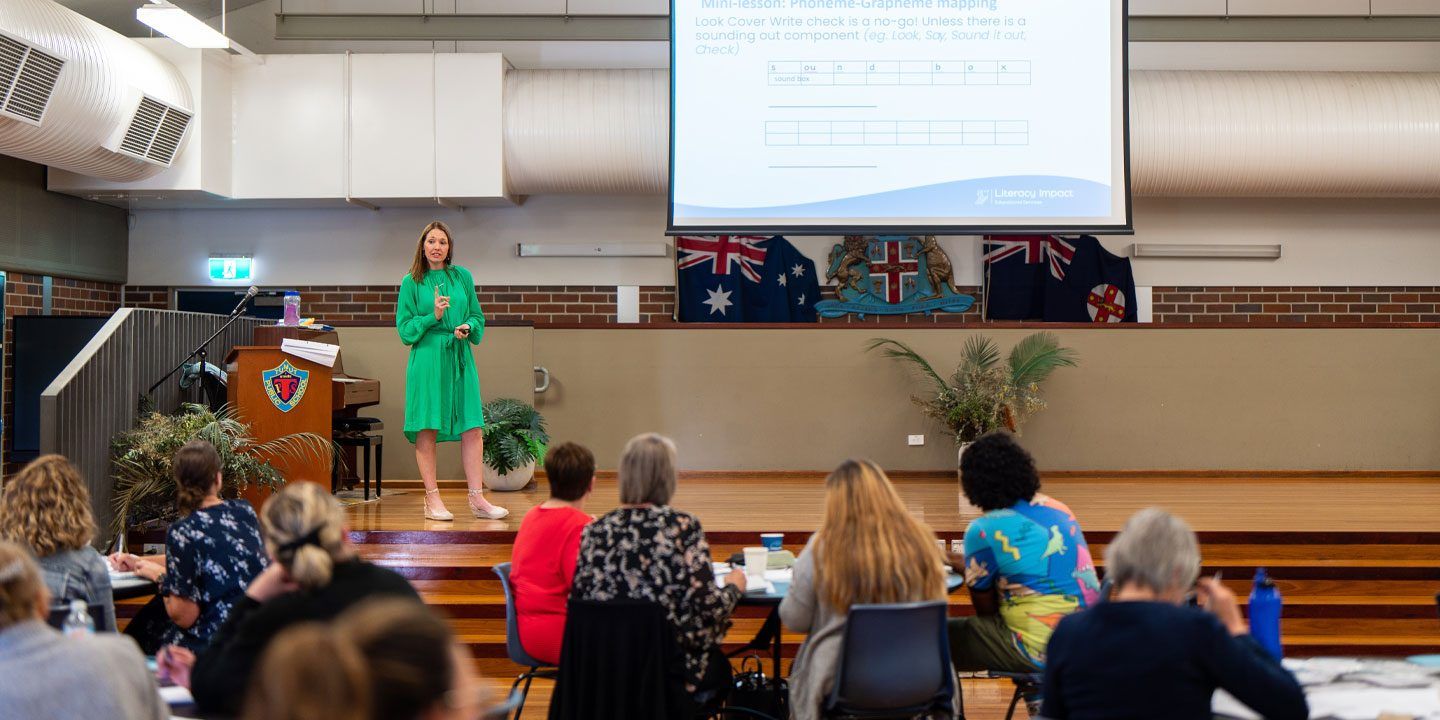
I help school leaders find what’s holding students back, strengthen teaching in every classroom, build the conditions for sustained change and lift reading and writing results schoolwide.
Trusted by 100 schools across Australia
This is for you if
On paper, it looks like it should be working. So why isn’t it?
For principals, deputies and literacy leaders who have done the work, and still aren’t seeing the data move.
You have a whole school approach to structured literacy and explicit instruction. So why are so many students still below benchmark?
Literacy is a priority in your school improvement plan. So why is NAPLAN declining, or not improving at the rate you expected?
You have intervention in place. So why does the intervention list keep getting longer?
The School Improvement Blueprint™
Whole school literacy improvement, in four parts.
You’ve introduced a structured literacy approach, invested in professional learning days and timetabled collaborative planning. Yet your student data isn’t shifting as much as you hoped, practice varies between classrooms and the intervention list keeps growing. It’s rarely a knowledge or effort problem, and that’s what the Blueprint is built to solve: a proven system and methodology, underpinned by research.
1. The issue
Know exactly why student data isn’t shifting. Pinpoint where reading and writing are breaking down, using your school’s data, classrooms and staff feedback, then set the direction with clear, measurable goals.
2. The Architecture for School Excellence™
Build the conditions for equity and school excellence. A clear moral purpose and goals, strong preconditions, agreed understandings of how students learn, what and how we teach, Tier 1 excellence with tiered support for diverse learning needs, and a literacy leadership team that keeps it all aligned. All of it is adapted to your school’s context.
3. The Implementation Pathway™
Lead the change in the right order, at the right pace, within the time you already have. Your priorities become a sequenced literacy action plan, aligned with your school improvement plan and staged in manageable five week cycles of implementation and review. We identify what can be streamlined or paused, share the work across your leadership team and build in coaching and feedback, so the work doesn’t rest on one person.
4. The impact
Improved reading, spelling and writing outcomes from one year to the next. Progress is measured against your school’s own baseline. Tier 1 is strengthened so fewer students need intensive support, and practice is embedded in guides, scope and sequences and induction, so it holds when staffing changes.
Schools don’t improve literacy by adding another program. They improve by building a coherent, evidence based system in the right order, led well, over time.
Impact
When the right conditions are in place, student outcomes can accelerate.
67% → 5%
Prep students in the highest reading risk category.
Crib Point Primary School, VIC
50% → 80%
Year 4 oral reading accuracy, in four months.
Aldercourt Primary School, VIC
50% → 1.4%
Year 7 students at significant risk in oral reading accuracy, in five months.
Monterey Secondary College, VIC

Meet your school improvement partner who has led this work from inside schools.
National literacy improvement specialist, author and former school leader, with more than 25 years’ experience across Australia and the UK.
- 2025 LDA Bruce Wicking Award
- Former Deputy Principal
- Grattan Institute expert panel
- Author, Amba Press
- SSEN:D Advisory Board
- SRSD work endorsed by Dr Karen R. Harris
Why Literacy Impact™ exists
Australia doesn’t have a literacy effort problem. It has a literacy systems problem.
Literacy changes the trajectory of a child’s life.
Every day, far too many Australian children move through our schools without the literacy skills that shape almost every future opportunity. That isn’t for lack of passionate teachers, committed leaders or hardworking schools.
In more than 25 years as a teacher, SENCO, Deputy Principal and consultant, I have seen the same gap. The effort is enormous. The impact isn’t.
Two things are usually missing: an architecture for excellence, and a clear pathway for leaders to build it. I know, because I was one of those leaders, relying on instinct and hard work.
Through Building Literacy Excellence™, your leadership team builds that system and learns how to lead and sustain it, so reading and writing improve from one year to the next.

Signature partnership
Building Literacy Excellence™: whole school literacy improvement
A one year strategic partnership that removes the guesswork: know what to change, in what order, and how to embed it, so the work is sustained when staff change.
What’s included
- Online leadership intensives for the leading literacy team
- Online strategy sessions during WA school terms
- Personalised Roadmap planning sessions
- Literacy Excellence Health Check™ and an individualised 12 month Literacy Improvement Roadmap™
- Whole school professional learning days
- Expert feedback on classroom instruction
- Lifetime access to the Leading Literacy Impact™ masterclass and Resource Vault for up to four leaders, to use across the school
- Four copies of Julie’s book, plus writing resources, planners, scope and sequences, instructional guide templates and staff meeting materials
Your first 30 days: Clarity
- Know why your data isn’t shifting. Audit and diagnosis of where reading and writing are breaking down, and why effort isn’t translating into impact.
- A Literacy Excellence Health Check™ report. Identify strengths, underlying gaps and priorities.
- Know exactly where to start. One to three high-impact starting points, with increased clarity and direction.
- Have a roadmap your team can follow. A personalised 12-month roadmap, aligned with your school improvement plan and context.
- Make the work fit. You’ll identify what can be streamlined or paused, with named responsibilities and a rhythm for reviewing progress.
- Share one language for the work. Your leadership team will have a shared understanding of the preconditions, the architecture and the implementation pathway behind school excellence.
You’ll know where to start, why it matters and what your team does next.
Your year at a glance
First 30 days
Direction
Your Health Check™ and school data uncover the underlying issues and set the direction with clear, measurable goals, an individualised 12-month roadmap and high-impact starting points for early wins.
Term 1
Clarity
Know exactly where impact is leaking and what to do first. Core routines running, screening underway, leadership structures in place.
Term 2
Capability
Every teacher equipped with the knowledge and routines that lift learning: an agreed literacy block, data chats, phonics and spelling to mastery.
Term 3
Consistency
Low-variance teaching in every classroom, with systems for diverse learning needs: intervention pathways, progress monitoring, shared writing rubrics.
Term 4
Continuity
The work keeps going when people change: SRSD for text-level writing, a codified playbook and instructional guide, induction for new staff.
Your investment. One annual investment per school, including up to four leaders. Pay upfront or across two semester payments.
How to start
Three steps. Nothing is signed until you are sure.
1
Apply
Tell us about your school and what you most want to solve, in three quick questions.
2
A 15 minute fit call
A short conversation about where your school is now and whether the partnership is right for you.
3
A 30 minute planning meeting
Where there is a fit, we map out goals, scope, dates, responsibilities and investment, all confirmed before you enrol.
Targets are set from your school’s own baseline and tailored to your school’s context.
Other ways to start
Not ready for a full year? Two smaller ways to start.
Online leadership modules
Leading Literacy Impact™
“We know what needs to change. We need to know how to lead it.”
$890 inc GST for four lifetime leadership licences
One day, with your leaders
Literacy Excellence Audit & Strategy Day™
“We need clarity about what to fix first.”
$3,500 inc GST
Not sure where your school fits? Book a 15 minute Literacy Clarity Call →
Frequently asked questions
What does a literacy consultant for schools do?
A literacy consultant helps schools identify literacy gaps, strengthen teaching practice, get more from their literacy programs and improve student reading and writing outcomes. At Literacy Impact™, Julie works as a literacy improvement specialist and school improvement partner rather than a consultant, and the work is grounded in evidence based research in the science of reading, writing, effective school conditions and implementation science.
How long does whole school literacy improvement take?
Lasting whole school improvement takes sustained, focused work. That is why Building Literacy Excellence™ runs as a one year partnership: direction in the first 30 days, classroom change through the year, and systems that protect the work before the year ends. However, depending on a school’s starting point and specific contextual factors, school improvement can take between two and three years.
We’re already stretched. How can we take this on?
BLE is designed to make the time you already have count. Before you start, we look at what can be streamlined or paused, and redirect existing staff meetings and PLCs to the work. Throughout the year, tools, planners and slide decks are ready-made for your exclusive use, so your team isn’t building from scratch.
We’ve invested in PL before and it didn’t change much. Why is this different?
One-off PL rarely changes classroom practice. Literacy Impact™ PL is grounded in evidence based research on effective professional learning, with very clear practice based learning embedded. BLE builds what makes it stick: five-week implementation cycles, coaching, video feedback, data routines and codified practice.
What if we don’t yet have staff buy-in, or staff push back against the change?
Resistance usually comes from unclear expectations or change fatigue, not unwillingness. We start with low-risk, high-impact routines that give early visible wins, and support leaders through the harder conversations. At Tumut Public School, 100% of classes were explicitly teaching vocabulary every day within six weeks. We also know that although full staff buy-in is ideal in the early days, it is unrealistic in most school contexts. Buy-in frequently comes with data shifts and visible wins, which is why we support the leading literacy team to build the why for change and the moral purpose, and to start with ready ‘champions’: early adopters who can demonstrate early transformational growth in student data and staff confidence. In the partnership, we support you to work through these barriers or challenges.
Is Building Literacy Excellence™ suitable for secondary schools?
Yes. The pathway is contextualised to your data, curriculum demands and priorities. At Monterey Secondary College, routines such as gist statements are now used across subjects from Years 7 to 12.
Do you work with schools outside Western Australia?
Yes. Julie is based in Perth and works with schools and systems across Australia. Much of the leadership work runs online, so distance is not a barrier.
Will this work in our context?
The pathway starts from your data, not a template. Documented results span a remote, high EAL/D school in the NT, a primary school with a below-average ICSEA, a high-ICSEA primary, a low-SES secondary, early years and preschool settings and a three-campus independent school.
We already have programs in place. Do we need to replace them?
Usually not. We look at what to keep, strengthen, change or pause, and whether current programs are implemented consistently and connected to your data. However, where approaches are not evidence based or evidence informed, we will let you know and suggest alternatives suited to your context.
What happens if a key leader leaves during the year?
BLE includes up to four leaders, and the work is codified into guides and protocols. That’s exactly so it doesn’t rest on one person.
Where should our school start?
If you are not sure, start with the Literacy Excellence Health Check™ or book a 15 minute Literacy Clarity Call. You do not need to know the answer before we talk.
Next step
Let’s talk about your school.
You don’t need to have the answer before we talk. You may simply know current outcomes aren’t what you expected. That’s where we start.